
On June 24, Venezuelans were struck by two powerful, back-to-back earthquakes, each measuring more than seven points on the Richter scale. The destruction is widespread, especially in Caracas and the coastal city of La Guaira. There’s now more than a thousand dead and thousands missing, but those numbers are going to grow. One hesitates to politized natural disasters, to rush to impose some larger moral geopolitical morality on heartbreak. But—considering that Washington has placed Venezuela in receivership and has seized billions in oil revenue, depositing the money in US escrow accounts—it’s hard not to. Over the lasts two decades, Washington has sanctioned Venezuelans to death. The White House, in the wake of the quakes, has lifted some of those sanctions, but the damage has been done, leaving government and society with a significant lower capacity to cope with the damage. The United States flew 149 Venezuelan deportees, including 19 women and seven children, from Miami to Caracas just a few hours before Wednesday’s earthquakes. They were brought to brought to the Hotel Santuario La Llanada in La Guaira, which collapsed. Hundreds remain missing.
What follows is an account of an earthquake that hit Caracas in 1812, one whose aftershocks changed the world. The quake led to the end of Spanish America’s first independent republic but propelled a young Simón Bolívar to the head of a continental insurgency that, about a decade later, would topple the three-century old Spanish Empire. It’s an adapted excerpt from my America, América: A New History of the New World, which is now out in paperback.
Thursday, March 26, 1812, Caracas: What image better captures the cusp between old and new than Simón Bolívar standing defiantly on a mountain of rubble? His audacity signaled not just the beginning of the end of Spanish colonialism but the breaking of the chain that linked slave, peasant, servant, man, woman, priest, master, lord, and king in a hierarchy reaching to the sky, a sky crisp and clear that tragic Thursday. The earthquake had destroyed most of the city and its hinterlands. At one point, Bolívar, who was back in Caracas from his military campaigns when the quake hit, drew his sword on a priest and ordered him to stop praying for souls and start saving lives. Pull bodies out of the rubble, Bolívar ordered the cleric. After scrambling atop a high pile of stones from a ruined convent, Bolívar came face-to-face with José Domingo Díaz, a medical doctor loyal to Spain who for two years had written weekly polemics against the foolish dreams of republican liberation. Bolívar, as Díaz described him, looked desperate.
“What now?” Díaz asked, as if mocking the republican arrogance that it was history that mattered, that it was history that could be overcome by man’s will—that it was history and not nature that decided who ruled. Bolívar’s answer came back quick: Si se opone la naturaleza lucharemos contra ella y la haremos que nos obedezca: If nature itself opposes us we will fight nature and make it obey.
There’s nature as reason, as a justifier of beliefs and ideals. And there’s nature as force, impulsive, terrifying, and marvelous. Bolívar, climbing the convent’s rubble and pledging that he would compel nature to submit to republican will, was defying both. He wasn’t disputing the royalist argument that the natural disaster was a manifestation of God’s displeasure. But if true, then God’s will had to be defeated and the old world He presided over had to end. During this moment of earthshaking crisis, Bolívar was Milton’s rebel angel hurling defiance toward the vaults of heaven. If nature stood in the way, nature would be destroyed.
After surviving Caracas’s 1812 earthquake, Bolívar would spend the next 12 years of his life waging war against Spain, and against the institution that enriched Spain: slavery, in all its many guises.
Caracas had been suffering from a long drought that spring, and the sky was blue on the day of the quake. But a few raindrops fell just before the church bells started to ring: at 4:07 in the afternoon, not to mark time but because their towers were swaying. The undulations of the earth came from different directions, north to south, and east to west, like two waves cutting across each other.
The city sat at the intersection, and the waves crashing together sounded like thunder rising from “hell,” one survivor said, like the “voice of the Angel of the Apocalypse.”
Columns gave way. Balconies fell. The timing of the earthquake was uncanny. March 26 in 1812 was Maundy Thursday. On that day two years earlier, Caracas had expelled its royal overseers. On that day one year earlier, the city had commemorated the expulsion in a wild night of revolutionary exuberance, and then shortly thereafter declared independence. Believers were in the city’s many churches and convents celebrating Mass when the buildings started to collapse, and many of them, maybe most, were crushed to death. When the sun went down at 6:10, the dust rising from the rubble deepened the darkness. The “lamentations” of those buried beneath the ruins “lacerated the heart,” recalled one witness. The destruction was near total, the terror absolute. Washington’s envoy to the new republic estimated that 20,000 people had died immediately, and tens of thousands more would perish in the weeks to come from hunger, disease, and injury. Church buildings in wealthy mantuano parishes were made of heavier stone, with larger buttresses, so most of them remained standing. Casually built churches in poorer areas of the city nearly all collapsed, crushing the city’s servants, along with their children. This meant that there was a shortage of laborers and domestics to help upper-class families recover: a preview of what a world without slavery might look like.
The quake radiated hundreds of miles beyond Caracas. Town after town fell, with waves felt as far west as Bogotá in Colombia. Storehouses collapsed, burying shovels and other needed tools, medicines, linen, and food. Rescuers used their bare hands to dig survivors out from the rubble. The quake blocked springs and broke pipes running to public fountains, so there was little safe water to drink or to clean wounds. Suddenly, for the well-off, the abstractions of revolutionary slogans proclaiming liberty and equality were materialized in their worst fears: The city’s poorer survivors were seen “entering the houses that were still standing” and “carrying off everything they could lay hands on.” Some called it looting, though it might more rightly describe survival. To prevent the spread of disease, bodies were burned by the dozens. Corpses were carted to the beach of La Guaira, Caracas’s port town. There, they were burned “about forty at a time in one fire,” with the flames visible to ships far out in the Caribbean.
“The City has disappeared,” wrote the Prussian naturalist Alexander von Humboldt, who had visited Caracas during his American travels, upon reading of the catastrophe. So too, for many, republicanism. Congress held its last session on April 6, 1812.
Nine out of 10 prosperous caraqueño houses, compounds in the Andalusian style, thick adobe chambers surrounding lush courtyards, were destroyed. Simón Bolívar’s, just off the Plaza San Jacinto, survived. Its beams buckled but held. Witnesses recalled the 29-year-old Bolívar in a tattered, stained shirt with sleeves rolled up, alternating between pulling people from the wreckage and arguing with those who said the calamity was a divine strike against republicanism, against the “sin of independence.”
Disaster Royalism
Republicanism in Venezuela, as mentioned, wasn’t anti-Catholic. In Caracas, as well as in key provincial cities, especially in the Andean city of Mérida, there existed emancipationist priests, of the kind that might read a passage from Las Casas rather than a chapter of the Gospel while saying Mass. But a larger, opposing group was mobilized by Archbishop Coll y Prat. A few conservative clerics had been preaching for years against republican perversity, warning of the wrath that might befall a people arrogant enough to believe they could rule themselves. Others held their tongue. Until Caracas collapsed.
The archbishop, born in the Cataluña foothills of the Pyrenees, urged his priests to preach disaster royalism. They were to tell people that “hell was opening to swallow them.” Clerics cited the fact that the city’s buttressed cathedral was spared destruction as evidence that God protected the faithful. Christ’s Crucifixion, people were reminded, was followed by a similar upheaval: “And the earth did quake, and the rocks rent.” The destruction was “terrifying,” Coll y Prat remembered. But “well deserved.” The earthquake “confirmed for our times the timeless prophecies revealed by God to men about the ancient cities impious and proud: Babylon, Jerusalem, and the Tower of Babel.”
Royalists who had previously fled republican Caracas, many to Caribbean islands where no integrated balls were held, came home. They brought with them a new stock of servants and a strong dose of Catholic revivalism, including exaggerated displays of public penance. Survivors and returnees roamed the streets in impromptu processions, dressed in sackcloth, dragging makeshift crosses, and confessing their sins. The churches left standing were packed day and night, and anyone who didn’t, according to one account, “surrender himself to the ridiculous mania of living in penance was regarded as a dissolute libertine who provoked the anger of heaven.” Not just republicanism but all transgressions were regretted. Couples living together out of wedlock sought out priests to marry them. Fathers recognized their bastards. Republicans lost their audience.
The drought let up after the quake. Hard rains that would have been welcome in any other year now tormented a city not given time to repair its roofs or drainage systems.
Caracas’s conservative clerics were quick to seize on the marvelous to strike at the republic. Aftershocks continued for weeks; another large quake on April 5 threw the ground into a “state of perpetual undulation.” For many, there existed “only one recourse.”
Make peace with God. And stop calling one another citizens.
Chastisement of Heaven
In Spain, the Cortes de Cádiz had been too occupied fighting Napoleon to mount a full military campaign against republican Venezuela. It left the pacification initiative to a loyal, poorly armed frigate captain named Domingo de Monteverde. Short on men, Monteverde had begun to try to win over some of those insurgentes de otra especie who were stirring in rural Venezuela. Before the earthquake, Miranda and Bolívar, as leaders of the republic’s defending army, had kept Monteverde in check. After the quake, though, with disaster Catholicism spreading fast through the land, the counterrevolution grew.
The United States hadn’t officially recognized the Venezuelan republic, but it did send a consul, Robert Lowry, to Caracas’s port city of La Guaira to monitor events. In June, he reported to Secretary of State James Monroe that royalist forces had “penetrated” deep into the interior. Monteverde’s army was growing with “superstitious” recruits who had been “excited by the Priesthood.” The earthquake, they were told, “is a chastisement of Heaven for abandoning the cause of Ferdinand the Seventh.”
The counterrevolution had begun to consume the revolutionaries. The Sociedad Patriótica successfully demanded that the government name Miranda “dictator,” giving him extraordinary powers to put down royalists. Miranda ordered the arrest of all Spaniards and Canary Islanders (mostly merchants who had prospered under Spanish mercantilism and were thus hostile to the independence movement).
The republican army had been enfeebled by the quake and the chaos of its aftermath. So Miranda took steps to bolster its ranks by finally fulfilling a promise that he had made to British abolitionist William Wilberforce to end slavery. The revolution had already ended the slave trade. Now, Miranda issued a decree promising “liberty for all slaves that take up arms for Venezuela.” The city’s white elite and conservative clergy were outraged. They understood Miranda’s edict as “an attack on their property and dissolvent of the social order,” a perilous unleashing of forces best kept chained.
A tipping point had been reached. In response to Miranda’s decree, anti- republicans did the same. They began to mobilize people of color. Archbishop Coll y Prat sent secret instructions to priests in the provinces to encourage enslaved and free Blacks to fight in defense of our “legitimate sovereign.” A rumor spread throughout the provinces that the archbishop had been taken prisoner, and soon a column of armed people of color was marching on the city to rescue the cleric and “end the republican government.” By the end of June, reports came in that large stretches of the coast east of La Guaira were under the control of royalist negros and pardos. Miranda had pulled troops out of the city to attack Monteverde, leaving Caracas undefended against the archbishop’s would-be rescuers, whose battalion was 12 leagues from the city’s gates and moving fast.
Miranda didn’t have the will or heart to fight back. He was, at this point, carrying on back-channel communications with London officials, who were urging moderation. Miranda opened talks with Monteverde, and, in exchange for being allowed to return to London, surrendered on July 25, 1812. Spanish America’s First Republic was no more.
Bolívar was enraged. Miranda might have believed he had no choice, but his former comrades charged him with treason. Still, Miranda, caught in his lassitude, delayed his departure for London and that delay allowed a group of revolutionaries, including Bolívar, to capture the old general and turn him over to the royalists. What exactly happened next is unclear, but Monteverde’s promise of safe passage was revoked. Royalists sent Miranda to Spain, where he died in a prison cell on July 14, 1816, on the 27th anniversary of the fall of the Bastille. Bolívar, after giving up Miranda, gave up the fight as well, for the moment. Monteverde’s troops allowed him and a handful of revolutionary officers to escape to the English island of Curaçao, on a small sailboat named Jesús, María y José, where the exiles were given shelter by Mordechai Ricardo, an Amsterdam-born Jewish lawyer (and cousin of the economist David Ricardo).
Monteverde entered Caracas at the end of July and began arresting the city’s remaining republicans, including the drafters of the Declaration of In- dependence and the constitution. Calling them “monsters of America,” Monteverde imposed, according to the United States envoy charged with delivering food relief, a “system of proscription, sequestration, imprisonment, and cruelty almost unexampled.” They were put in irons and thrown into dungeons, “noxious in all countries, but doubly fatal in a climate like this.”
The Country Is America
Taking control of Caracas was relatively easy. More difficult for Monteverde was putting down the rural insurgentes de otra espiece, including those he had mobilized himself. The column determined to rescue Archbishop Coll y Prat was now camped on the outskirts of the city. The archbishop sent a message ordering slaves and peasants to return to their masters. The church was safe, I am safe, he said. The leaders of the march refused to disperse. Instead, they invoked Miranda’s decree, saying that by fighting for king and Church they should receive their freedom. “Nonsense,” said the archbishop. We “promised you nothing.”
The leaders of the assembled masses let Spanish officials know that their allegiance was conditional. They had already killed several of their “masters, overseers, and many whites” and could easily expand their ranks, raising an army of thousands of enslaved and free Blacks. “All armed,” as the archbishop’s envoy noted. Suddenly, victorious royalists were faced with the prospect of having to fight the forces that helped carry them to victory. As the archbishop’s envoy noted, the ragtag army bivouacked outside of Caracas could easily live off the land. “They all have been hardened by labor and the torrid heat.” Rumors began to circulate that their leaders were in contact with republicans, who didn’t hesitate to confirm that if they switched sides, they would indeed be emancipated.
Negotiations averted a siege of the city, and the “black corsairs,” as the archbishop called them, retreated. But Venezuela fell into chaos. Monteverde was injured in battle in October 1813 and eventually relieved of duty.
To the fore of the royalist pacification campaign came a ruthless horseman from the eastern llanos, or grasslands, named José Tomás Boves. Royal officers had released Boves from prison, where he was being held on charges of smuggling, and, after witnessing his merciless efficiency in the field, set him loose.
Essentially operating as a paramilitary field marshal, Boves practiced a unique form of royalism, which consisted in the waging of relentless class and race war. He held an implacable hatred of both republicans and Venezuela’s antirepublican landed aristocrats. His army, at its height, counted 7,000 men, mostly former slaves, cowherds, and peasants, who raised a piratical black flag—what he called his “banner of death,” adorned with a skull and crossbones and the words “Liberty or Death”—in every town they occupied. They slaughtered republicans by the thousands and terrorized white aristocrats, threatening to divide their great estates among the impoverished masses. All in the name of King Ferdinand.
Meanwhile, Bolívar, who had eventually made it to Cartegena, in Colombia, regrouped. He raised troops and rode back to Caracas, defeating all opposition and taking the city again in 1813. But in the countryside, Boves’s army was growing, cutting a line of mayhem through the provinces. Caracas, at least, was again in the hands of republicans, the capital of a “Second Republic.” But Bolívar was no longer interested in creating a besieged backwater nation on the littoral of a vast continent. He became the agent of his mentor Miranda’s grander vision, pledging himself to fight for a greater America. “Para nosotros la patria es la América”—For us, the country is America, he declared in one field speech.
Bolívar, on June 15, 1813, in the city of Trujillo, decreed a “war to the death.” It wasn’t just a figure of speech. The struggle to recapture Valencia had given Bolívar a sense of how deep-rooted royalism was in the countryside and an awareness that it would take significant coercion to defeat monarchical allegiances. He wanted his troops to terrorize Spanish loyalists, to avenge the “horrific desolation” left behind by Monteverde and the atrocities committed by Boves. Tactically, he wanted the remaining “accursed race of European Spaniards” to know they had three choices: accommodate to independence, return to Spain, or die. Spaniards who conspired with the enemy would be considered traitors and executed. Those who joined the rebels would be given an “absolute pardon.”
Bolívar was making it clear that the war was not simply a colonial rebellion but a conflict between two nations, Spain and America. Once set loose, such furies were hard to contain. The more Spanish heads his soldiers took, the faster they rose in the ranks. Some of the first such trophies to arrive at Bolívar’s camp were cut from the corpses of an elderly aristocratic husband and wife, along with a note written in the victims’ blood.
Churches Filled with Blood
Boves continued his own war of extermination. In early February 1814, in the town of Ocumare, his army pillaged, raped, and murdered, cutting off “the noses and ears of inhabitants, the penises of the men and the breasts of women.” “Blood was everywhere.” Survivors took refuge in the Catholic Church. Boves’s marauders murdered everyone they found inside. In retaliation, Bolívar ordered the execution of hundreds of Spanish prisoners. Historians guess that, between February 14 and February 16, 1814, as many as a thousand Spanish prisoners were shot or macheted to death.
Earlier, during the First Republic, political terror had been relatively contained. That restraint now fell away. Bolívar thought mass executions would force Spanish officials to curb Boves. If the Spanish knew that they’d pay “dearly” for Boves’s “atrocities,” they would rein him in. Bolívar was wrong. Royal officers had no control over Boves.
By June, Boves had begun his march on Caracas. Along the way, Massacre followed massacre, with Boves’s men building pyramids with the heads of decapitated victims.
Bolívar couldn’t defend Caracas. His generals and their troops, having suffered staggering losses, were dispersed, and Bolívar didn’t want to test the loyalty of the people of the provinces, who he feared would join with Boves upon his advance. On July 6, 1814, he ordered Caracas evacuated. Thus ended the short-lived Second Republic. Twenty thousand residents hastily gathered what they could and left their homes, with republican officers stripping the churches of silver to finance the fight. With Boves descending on the city from the west, thousands fled eastward, while Bolívar escaped by sea. Boves entered Caracas and once again ordered the execution of all remaining white residents. There weren’t many left. He also ordered troops to pursue the refugees.
The exodus was chaotic. From the western plains to the eastern marshes, Venezuela was filled with roving armed men with shifting allegiances. Some refugees made it into republican-controlled territory. Others straggled. Thousands died, of snake bites, dysentery, and hunger, among other causes.
Boves’s troops moved fast. In October, his army arrived at the town of Cumaná, where a group of Caracas’s exiles had taken refuge. Another day of carnage. Another dance. This time, though, he had in his custody Caracas’s republican orchestra, headed by Juan José Landaeta (the composer of Venezuela’s national anthem, “Gloria al Bravo Pueblo”). He ordered the 30-member group to begin playing their instruments as his soldiers waltzed with the city’s widows. Blood from the day’s killing still moist on their boots turned the dance floor red. As the orchestra played, Boves took one musician out at a time to be executed. He ordered them to continue to play as he shot them in the head. When the last musician had been executed, Boves announced that the “party was over.” Then the rapes began.
“The roads and fields are filled with unburied corpses, the towns are leveled,” said a royalist tax collector, “the churches defiled and full of blood.”
Everything Will Become Nothing
Boves was a phenomenon difficult to explain. He turned everything on its head, a black flag–waving royalist waging a counterrevolution to spark a more profound revolution. He terrorized those who presumed themselves, due to their Spanish blood and white skin, immune to terror.
Boves shook Bolívar. Bolívar would continue to fight for more than a decade longer—as if he were sure the fight was worth it, as if he were certain that what came after Spanish rule would be better than Spanish rule. But he wasn’t sure. Boves represented a greater chastisement than any earthquake, a warning that the war against Spain would unleash powers resistant to reason, forces pulling Spanish America apart more powerful than those fighting to hold it together.
“All will return to its most basic element: matter,” Bolívar lamented during one of his dark moments. “Everything will become nothing.” His experience defending Venezuela’s republic deepened his conviction that a strong executive was needed to hold the forces of disunion at bay. Bolívar could express world-weariness in racist terms. “Guinea and more Guinea we will have,” he wrote, as it became clear that his enemy would not just be royalist troops and accursed Spanish but, in some places, masses of poor people of color. Yet for all his pessimism, Bolívar never posited race as an ontological category, an essence found in drops of blood.
Race was for Bolívar an artifact of history. Like Las Casas, whom he read and hailed as an “apostle” of freedom, Bolívar believed the Conquest was a crime, not just because of its violence but because it imprinted racial difference in its legal codes. “Everything that has come before us is wrapped in the black cloak of crime,” he sighed. The fight for independence wasn’t sparked by a divine touch from on high but came up through muck and mire, centuries of colonial exploitation: Spanish Americans, those who fought for and against independence, were “the abominable offspring of those raging beasts who came to America to spill her blood and to breed with their victims before sacrificing and discarding them.” Some of those beasts, like Boves, still prowled the land.
And Bolívar remained committed to emancipation, both as part of the republican ideal and as a military tactic, even though he feared that emanci- pation would evaporate elite support for republicanism. In Haiti to regroup and request assistance, which the free Haitian government provided (a thousand rifles, gunpowder, clothing, and military advisers), Bolívar pledged to continue to work to free South America’s slaves. “That portion of our brothers who have labored under the miseries of slavery is now free,” he said upon returning to the mainland; “From here forward, in Venezuela there is only one class of men: all will be citizens.”
Bolívar would continue to issue horseback emancipations, galloping from one hacienda to another and freeing its slaves if they promised to join his fight. Other revolutionary leaders in Argentina, Chile, and Peru—such as José de San Martín—did the same. Battalions of emancipated slaves helped win some of the most important battles of the independence movement, at Junín and Ayacucho, for instance. Montevideo, dubbed the New Troy after it lived under Spanish siege for more than a decade, never fell, thanks to its African defenders.
Nor did Bolívar, with Las Casas imprinted onto his consciousness, blanch from admitting that republicans were founding their new “free” nations on stolen land, that nationalism entailed its own form of colonialism. “We find ourselves engaged in a dual conflict: We are disputing with the natives for titles of ownership, and at the same time, we are struggling to create a new country.”
Whether such a new country could come into being or not—much less be a vehicle for justice—was a question left for the future. The fight itself was what Bolívar called an “obligation of atonement” to those who came before, especially to the “annihilated Indians” and their descendants. To break Spain’s hold on the New World was a debt “of the greatest transcendence.” Be there earthquakes or be there beasts like Boves, he’d fight on, even if “heaven has determined that our conquerors shall be our brothers.”
Popular
“swipe left below to view more authors”Swipe →
Boves was killed in battle by one of Bolívar’s men in 1814. Spain followed by dispatching an expeditionary army of 10,000 soldiers, along with a new suite of royal officials to impose order. The troops were led by Field Marshal Pablo Morillo. There wasn’t much left of Boves’s counterrevolutionary army, and those soldiers who had survived were in rags.
“If these are the victors,” Morillo asked, of the men who had defeated Venezuela’s Second Republic, “who are the vanquished?”
In the years to come, Bolívar would march through Indigenous communities, cattle lands, and haciendas worked by peons and slaves, continuing to offer freedom for all who joined the fight. Bolívar the utilitarian thought, abstractly, that racial divisions could be transcended with education. Bolívar the military leader hoped that war would create unity. Bolívar the existentialist doubted that any of it would matter.
And so by 1824, enslaved peoples were abandoning their masters and signing up to fight the Crown in exchange for their emancipation. Indigenous peoples came down from their highland villages, hoping that, after centuries of colonialism, their lot would improve under republican rule. One of the last battles of the long war for independence would take place in August, in the marshy highland plains of Junín, with Bolívar’s 8,000-strong army routing Spanish troops.
Save for a few last skirmishes, Bolívar had decisively defeated Spain.
Still, in victory, he remained haunted. He’d return again and again in future writings to history’s capriciousness, to a gloom that could rival the prophet Amos. “My time is a time of catastrophes: Everything created is destroyed in a flash, like lightning,” he wrote to his former vice president. “How foolish I was to believe I could stand firm in the midst of such convulsions, in the midst of so many ruins, in the midst of the universe’s moral upheaval.… It would be madness to see the storm that is coming and not take shelter.”
With the midterm elections now firmly upon us, the question is whether Democratic candidates will do more than merely occupy ballot lines as mild alternatives to the red-hot crisis that is Donald Trump.
As Trump spends over $1 billion a day on a globally destabilizing war on Iran and admits that he doesn’t “think about Americans’ financial situation,” millions across the country are struggling with the surging costs of essentials. Democrats must seize this moment and advance bold, small-“d” populist ideas—not settle for cynical caution that once again snatches defeat from the jaws of victory.
The Nation elevates progressive ideas, movements, and elected officials achieving real change across the country into the national conversation. At the same time, our journalists are exposing how crypto and AI-funded super PACs are spending hundreds of millions of dollars to knock out candidates they oppose, reporting on the devastating impact of the Supreme Court’s evisceration of the Voting Rights Act, and sounding the alarm on attempts by red states to quickly redraw electoral maps, disenfranchising Southern Black voters.
We can play this critical role because of support from readers like you. This June, we’re raising $20,000 to power The Nation’s independent journalism in the run-up to November’s immensely consequential elections.
It’s in our power to build a more just society, and your support at this critical moment brings us closer to that bold vision. I hope you’ll donate today.
Onward,
Katrina vanden Heuvel
Editor and Publisher, The Nation
More from The Nation
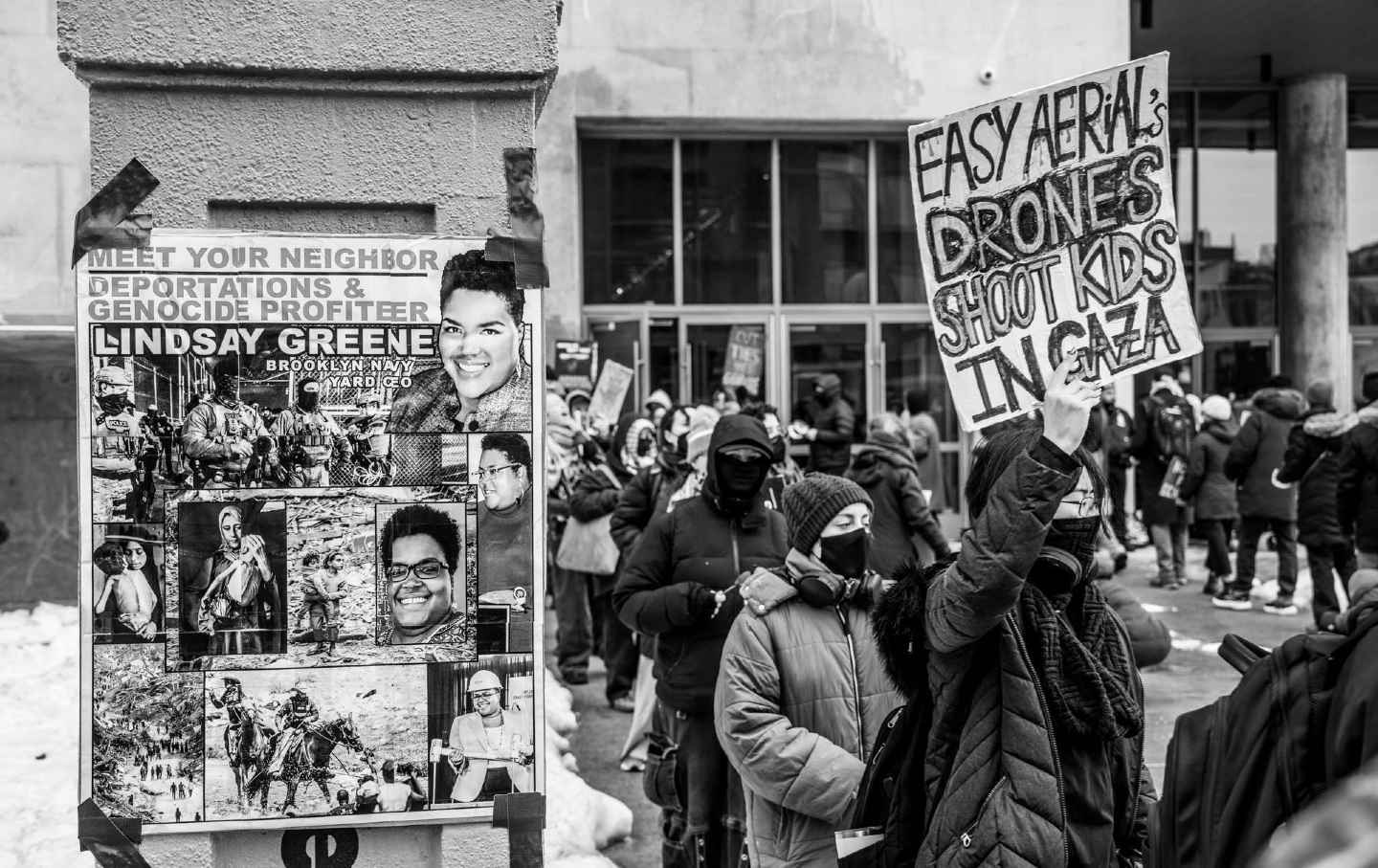
Newly uncovered documents have provided the first definitive proof that Israel’s largest weapons supplier is purchasing drones built in the Brooklyn Navy Yard.
Joseph Mogul
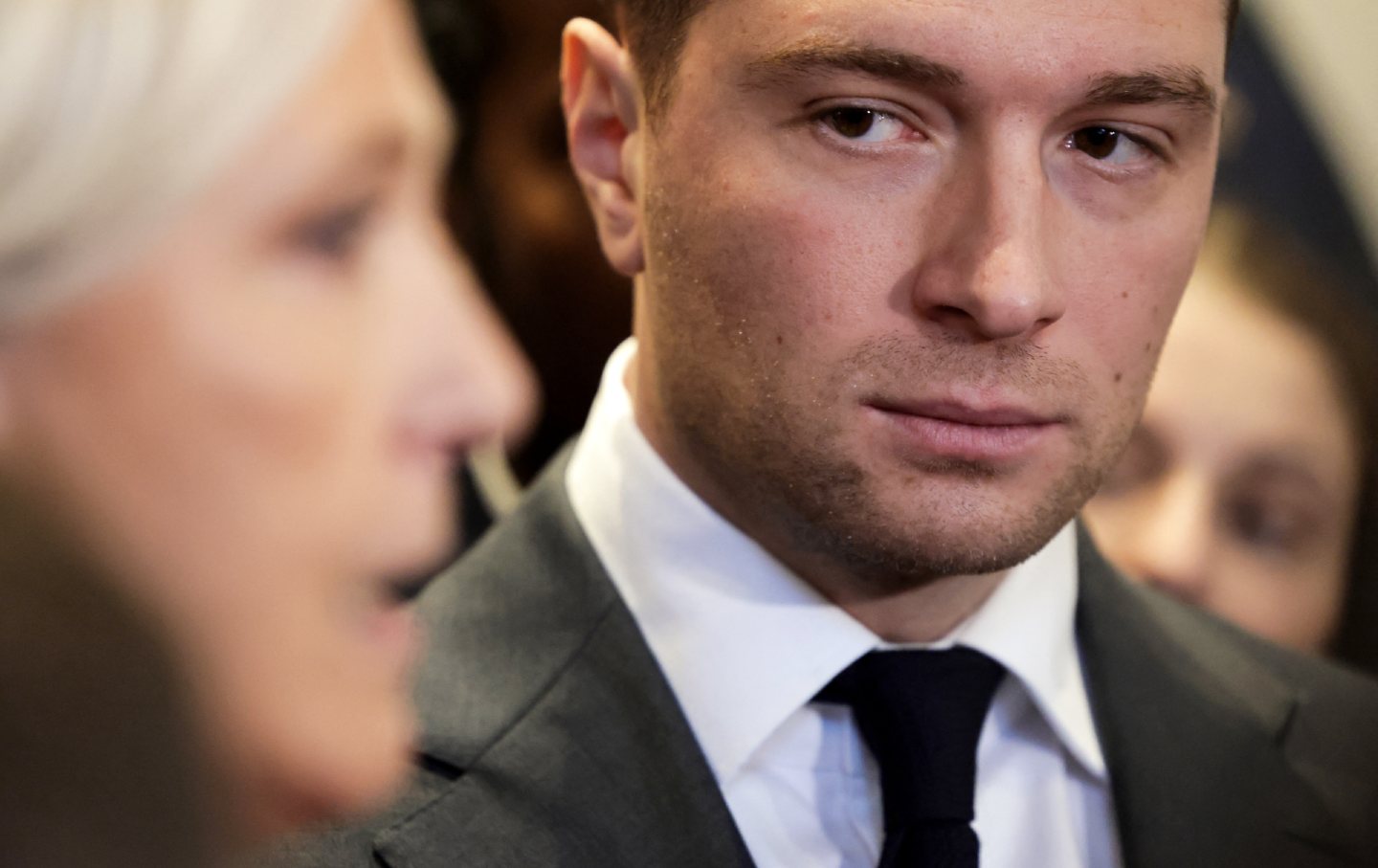
With Marine Le Pen facing a critical court ruling on July 7, leadership of the French far right is passing to her 30-year-old lieutenant.
Harrison Stetler
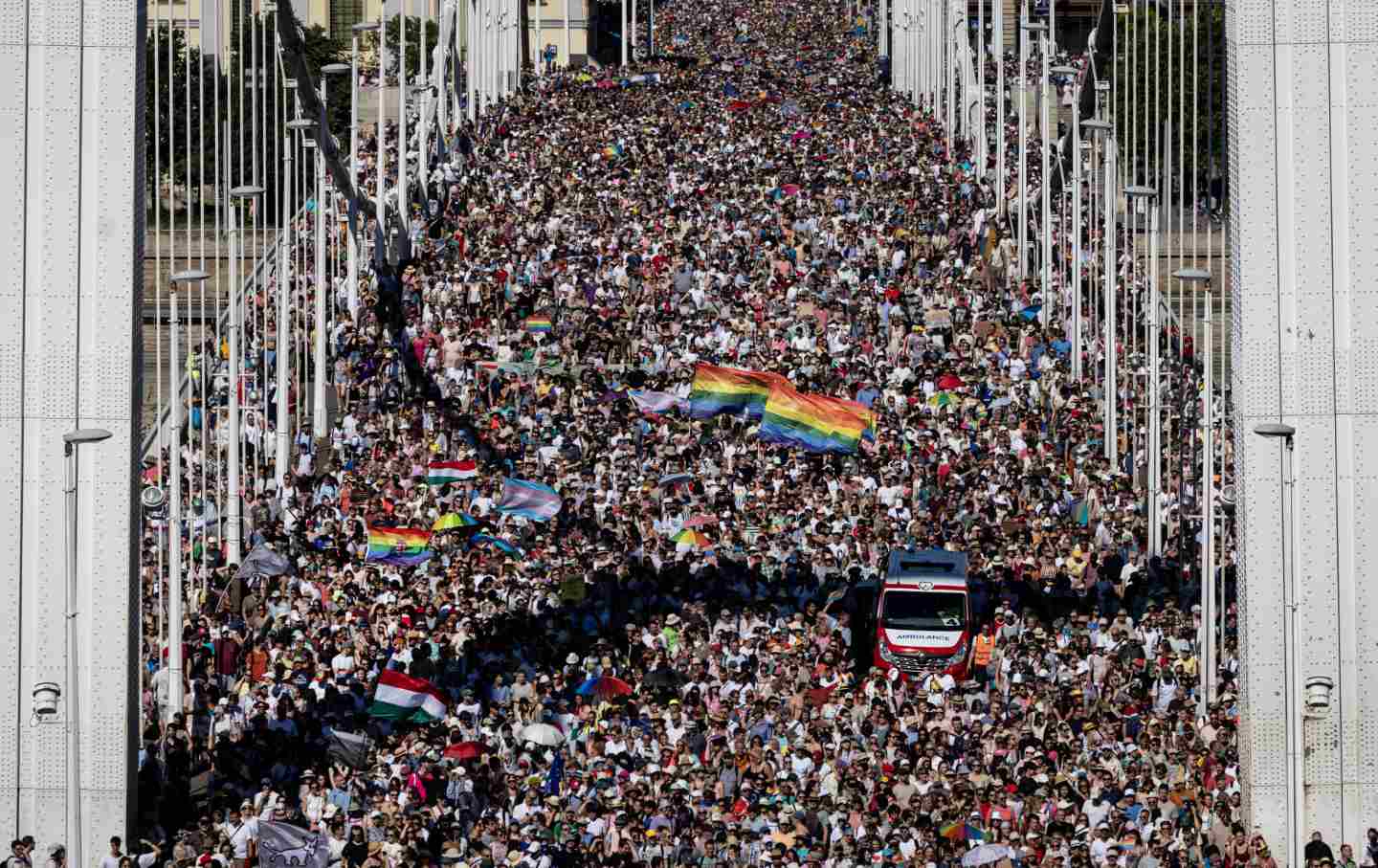
Around the world, governments are scapegoating LGBT people to build popular support for their erosion of individual rights—often under the guide of protecting children.
Ryan Thoreson
The amount of time spent in DC obsessing over Iran compared to the actual threat it poses to our country’s security is insane.
Matthew Duss
And how this is leading America’s Russia policy into dangerous places.
Dan Storyev